
Explore the latest stories and updates
FEATURED ARTICLE
The Maritime Data Problem: Stop Collecting More. Start Getting More Value From What You Already Have.
The Maritime Data Problem: Stop Collecting More. Start Getting More Value From What You Already Have.
Having spent much of our careers working with shipowners, ship managers and maritime businesses, one thing has become increasingly clear :
The industry doesn’t necessarily have a data problem. It has a data utilisation problem.
Most established maritime businesses already generate enormous amounts of information across their organisations. Vessel operations, technical management, procurement, crewing, commercial activities, HSQE, compliance, finance and corporate support functions.
The information is there. The systems are there. The people are doing the work.
But how much of that information is actually connected, consistent and being used to make better business decisions?
That is where I believe a significant opportunity exists.
Consider a fairly straightforward example.
A maritime business wants to understand why operational performance, productivity or costs are not improving in line with expectations.
Sounds simple enough.
But can management see how information flows between departments? Are operational, technical, commercial and support teams working with consistent and integrated information? Can the business identify duplicated activities, unnecessary manual intervention, process bottlenecks or recurring inefficiencies? Can management connect operational performance with the resources and costs required to deliver it?
Quite often, answering these questions involves extracting information from multiple systems, chasing different departments, reconciling spreadsheets and manually validating information.
And by the time the analysis is complete, the opportunity to act may already have passed.
This isn’t a technology problem alone. It’s an enterprise operating model problem.
Industry research reinforces the challenge. A 2025 survey of 121 professionals across container, bulk and RoRo terminals found that 53% faced challenges connecting internal systems, while 46% reported difficulties sharing data externally. Research by Lloyd’s Register and OneOcean also reported a data standardisation score of just 2.45 out of 4 on its Digital Maturity Index.
The question is not simply how we collect more information. It is how we make the information we already have work harder for the business.
Where would we start?
At Agilify Maritime, we believe the answer starts by looking at how the business actually operates — not by immediately recommending another software platform.
- Get the fundamentals right.
Establish consistent processes, definitions, reporting standards and data classifications across departments, business units and operational activities. If different parts of the organisation capture and interpret the same information differently, meaningful comparison and decision-making become difficult.
- Fix the gaps between systems, processes and people.
Understand where information is duplicated, manually transferred, re-entered or lost between departments. Identify where teams are working in silos, using disconnected systems or following unnecessarily complicated workflows. Then redesign the processes to make the organisation work more effectively as a whole.
- Establish ownership and accountability.
Put clear responsibility around data accuracy, process ownership, validation, controls and information access. Technology alone cannot create accountability. People and processes need to support it.
- Turn information into action.
Move beyond simply reporting what has happened. Identify recurring inefficiencies, performance gaps, resource constraints, process bottlenecks and opportunities to improve productivity. Give management the insight to understand what is happening, why it is happening and what action needs to follow.
- Make AI and automation deliver something tangible.
There is enormous potential to automate repetitive activities, improve information flows, streamline workflows, identify exceptions and support better decision-making across the enterprise. But AI cannot reliably compensate for inconsistent processes, poor data or unclear controls. The foundations need to be right, with appropriate governance and human oversight.
So, what would Agilify actually bring to the table?
We are not looking to sell maritime businesses another technology solution. Our starting point is to understand how the organisation operates today — across its people, processes, systems, data and controls.
We look beyond individual departments and examine how the different parts of the business interact. Where are the inefficiencies? Where is work being duplicated? Where are decisions being delayed? Where is information disconnected? And where could technology, automation and AI genuinely improve the way the business operates?
Importantly, we don’t believe in transformation for transformation’s sake.
We want to identify practical opportunities, prioritise what will make the biggest difference and work alongside our clients to implement improvements that can be measured.
That could mean simplifying operational workflows, improving cross-functional collaboration, strengthening governance and controls, making better use of existing technology, automating repetitive activities or creating a more effective enterprise-wide operating model.
The objective is simple: remove unnecessary complexity, improve how people and processes work together, and create measurable improvements in productivity, efficiency, service delivery and business performance.
We believe this is one of the biggest opportunities for maritime businesses today — and one that doesn’t necessarily require another major technology investment to get started.
Is this something your business is struggling with?
If you are a shipowner, ship manager or maritime executive who recognises these challenges, we would welcome a conversation.
At Agilify Maritime, we are keen to speak with businesses looking to take a fresh look at how their organisations operate — where processes, people, systems and data could work better together, and where practical improvements could create real business value.
No generic digital transformation presentation. No technology sales pitch. Just an honest discussion about how your business operates today, where the friction sits and where there may be an opportunity to do things better.
If you believe your organisation could be operating more effectively, let’s have a conversation
You can contact us directly here on LinkedIn or through info@agilifymaritime.com.
#Maritime #OperationalExcellence #MaritimeTechnology #DataGovernance #AI #DigitalTransformation
Advancing Maritime, Transforming Lives: Agilify Maritime Joins Forces with Mercy Ships
Agilify Maritime & Mercy Ships
Maritime Excellence with Purpose
The maritime industry connects the world, enabling global trade and economic growth. It also has the power to create meaningful change beyond business.
At Agilify Maritime, we believe success is measured not only by the value we deliver to our clients, but by the positive impact we create. That belief is the foundation of our partnership with Mercy Ships, a global humanitarian organization providing free, life-changing surgical care to underserved communities.
Together, we are demonstrating how innovation, expertise, and compassion can create lasting value—both within the maritime industry and beyond.
Empowering Smarter Maritime Operations
Agilify Maritime helps shipping companies improve efficiency, optimize costs, and accelerate digital transformation through scalable operational support.
Our solutions include:
Dedicated Offshore Support Teams
AI-Powered Process Automation
Finance & Accounting
Payroll Administration
Procurement & Claims Management
24/7 Travel Coordination
Intelligent Document Management
Business Process Standardization
Digital Transformation Consulting
Operational Reporting & Performance Analytics
By combining experienced maritime professionals with intelligent technologies, we help organizations simplify operations, strengthen compliance, improve performance, and scale efficiently.
Supporting a Mission That Changes Lives
For more than four decades, Mercy Ships has operated the world’s largest civilian hospital ships, delivering free surgeries, medical treatment, healthcare education, and professional training to communities with limited access to healthcare.
Staffed by volunteer medical professionals, maritime specialists, engineers, and support teams from around the world, Mercy Ships not only transforms individual lives but also strengthens local healthcare systems for generations to come.
Their work is a powerful example of how the maritime industry can serve humanity.
A Partnership That Creates Lasting Impact
Our collaboration with Mercy Ships reflects values that define both organizations:
- People first
- Sustainable, long-term solutions
- Collaboration across the maritime community
- Creating impact beyond business
A portion of every Agilify Maritime project is donated to Mercy Ships. Every client engagement therefore contributes to expanding access to life-changing healthcare while advancing smarter, more efficient maritime operations.
Partner with Purpose
Choosing Agilify Maritime means investing in operational excellence while supporting a greater purpose.
Together, we can build a more agile, efficient, and sustainable maritime industry—one that delivers value not only to businesses, but to communities around the world.
Transform your operations. Create lasting impact. Partner with Agilify Maritime.
The maritime industry is undergoing a significant transformation.
With global seaborne trade accounting for approximately 80–90% of world trade by volume, shipping companies face increasing pressure to operate more efficiently while maintaining the highest standards of safety, compliance, and service quality. As fleets expand and organizations grow across multiple regions and time zones, operational complexity often grows alongside them.
Processes that once worked effectively for a smaller operation can become fragmented across departments, vessels, offices, and systems. Operational data may be scattered across spreadsheets, emails, legacy software, and manual reporting mechanisms, making it difficult for leadership teams to maintain visibility and control over their operations.
The result is often a combination of inconsistent execution, compliance risks, limited operational visibility, and inefficient decision-making—all of which can impact profitability and long-term growth.
The Hidden Cost of Fragmented Maritime Operations
Many shipping companies continue to rely on manual processes for critical functions such as:
- Crew administration
- Procurement and purchasing
- Payroll management
- Financial reporting
- Voyage documentation
- Maintenance tracking
- Compliance monitoring
- Incident reporting
While these processes may appear manageable individually, they can create significant inefficiencies when multiplied across an entire fleet.
Common challenges include:
- Duplicate work across departments
- Delayed reporting and approvals
- Limited visibility into vessel performance
- Increased risk of human error
- Compliance gaps and audit findings
- Slow response times to operational issues
As organizations scale, these inefficiencies become increasingly costly and difficult to manage.
Why Standardization Matters
Standardized operations provide a foundation for consistency, accountability, and operational excellence.
By implementing structured workflows, centralized reporting, and dedicated support teams, maritime organizations can significantly improve operational control while reducing administrative burden.
Organizations that successfully standardize their support functions often experience:
Up to 40% Reduction in Operational Support Costs
Centralized processes reduce duplication of effort, improve resource utilization, and enable support functions to operate more efficiently.
Rather than increasing local headcount to support growth, companies can leverage dedicated maritime support teams that provide scalable operational assistance while maintaining service quality.
Up to 30% Faster Turnaround Times
Manual approval chains and fragmented communication often slow decision-making.
Standardized workflows supported by digital platforms allow information to flow more efficiently across departments, resulting in faster approvals, quicker issue resolution, and improved responsiveness to operational requirements.
Improved Accuracy and Compliance
Standardized procedures reduce the risk of errors in documentation, reporting, payroll processing, procurement activities, and regulatory compliance.
This creates greater confidence among stakeholders while helping organizations maintain alignment with industry regulations and internal governance requirements.
The Role of Technology and Artificial Intelligence in Maritime Operations
While process standardization is essential, technology is increasingly becoming a key driver of operational performance. ‘In data we trust!’. Fully integrated technologies with access to raw data to make timely and informed decisions is key to scaling operations.
Also Artificial Intelligence (AI) is enabling maritime organizations to move beyond reactive operations and adopt a more proactive, data-driven approach.
Today, AI applications are being used across various areas of maritime operations, including:
Predictive Maintenance
Traditional maintenance programs often rely on fixed schedules or reactive repairs.
AI-powered predictive maintenance systems analyze equipment performance data in real time to identify potential failures before they occur.
Benefits include:
- Reduced unplanned downtime
- Improved vessel reliability
- Lower maintenance costs
- Increased asset lifespan
Industry studies suggest predictive maintenance programs can reduce equipment downtime by 20–25% while significantly improving maintenance planning efficiency.
Fleet Safety Enhancement
Safety remains one of the most critical priorities for maritime organizations.
AI-powered monitoring systems can analyze operational data, vessel movements, equipment performance, and historical incidents to identify emerging risks before they develop into major safety events.
Organizations utilizing advanced monitoring and predictive safety tools have reported:
- Improved incident prevention
- Enhanced risk management
- Better compliance with safety protocols
- Increased situational awareness
These technologies can contribute to reducing safety incidents and operational disruptions by as much as 20–25%.
Automated Reporting and Documentation
Administrative tasks continue to consume a significant amount of time for maritime professionals.
AI-powered automation can streamline:
- Compliance reporting
- Vessel documentation
- Data entry
- Audit preparation
- Operational reporting
Digital reporting systems can reduce administrative workloads by up to 50%, allowing maritime professionals to focus on higher-value operational activities.
Voyage Optimization and Fuel Efficiency
Fuel remains one of the largest operating expenses for shipping companies.
AI-enabled voyage optimization platforms analyze:
- Weather conditions
- Sea state
- Vessel performance
- Route alternatives
- Historical voyage data
These insights help operators identify the most efficient routes and operating conditions.
Many organizations implementing AI-based voyage optimization have achieved 5–10% fuel savings, resulting in substantial cost reductions while supporting environmental and sustainability objectives.
Building a Smarter Maritime Organization
Technology alone is not the solution.
The most successful maritime organizations combine:
- Standardized operational processes
- Skilled maritime support teams
- Real-time operational visibility
- AI-powered analytics and automation
This integrated approach allows organizations to improve efficiency, strengthen compliance, enhance fleet safety, and create scalable operations capable of supporting long-term growth.
How Agilify Maritime Helps
At Agilify Maritime, we help shipping companies transform fragmented operations into standardized, technology-enabled workflows that improve visibility, consistency, and control.
Through dedicated maritime support teams, process optimization, and the strategic integration of digital technologies, we help organizations:
- Reduce operational support costs by up to 40%
- Accelerate turnaround times by up to 30%
- Improve operational visibility and reporting
- Enhance fleet safety and compliance
- Support scalable growth without increasing local headcount
As the maritime industry continues to embrace digital transformation, organizations that successfully integrate people, processes, and technology will be best positioned to achieve sustainable growth and operational excellence.
The future of maritime operations is not simply digital—it is standardized, data-driven, and intelligently connected.
How a Global Shipowner Reduced Operational Costs by Up to 40%
In today’s highly competitive maritime industry, shipping companies are under increasing pressure to optimize operations while managing rising costs and complex global demands. Challenges such as fragmented processes, limited scalability, and inefficient workflows continue to impact overall performance and profitability.
One global shipowner faced these exact challenges. With operations spanning multiple regions, the company struggled to maintain efficiency while keeping costs under control. As demand grew, so did the complexity of their operations—highlighting the need for a more agile and sustainable approach.
The Challenge
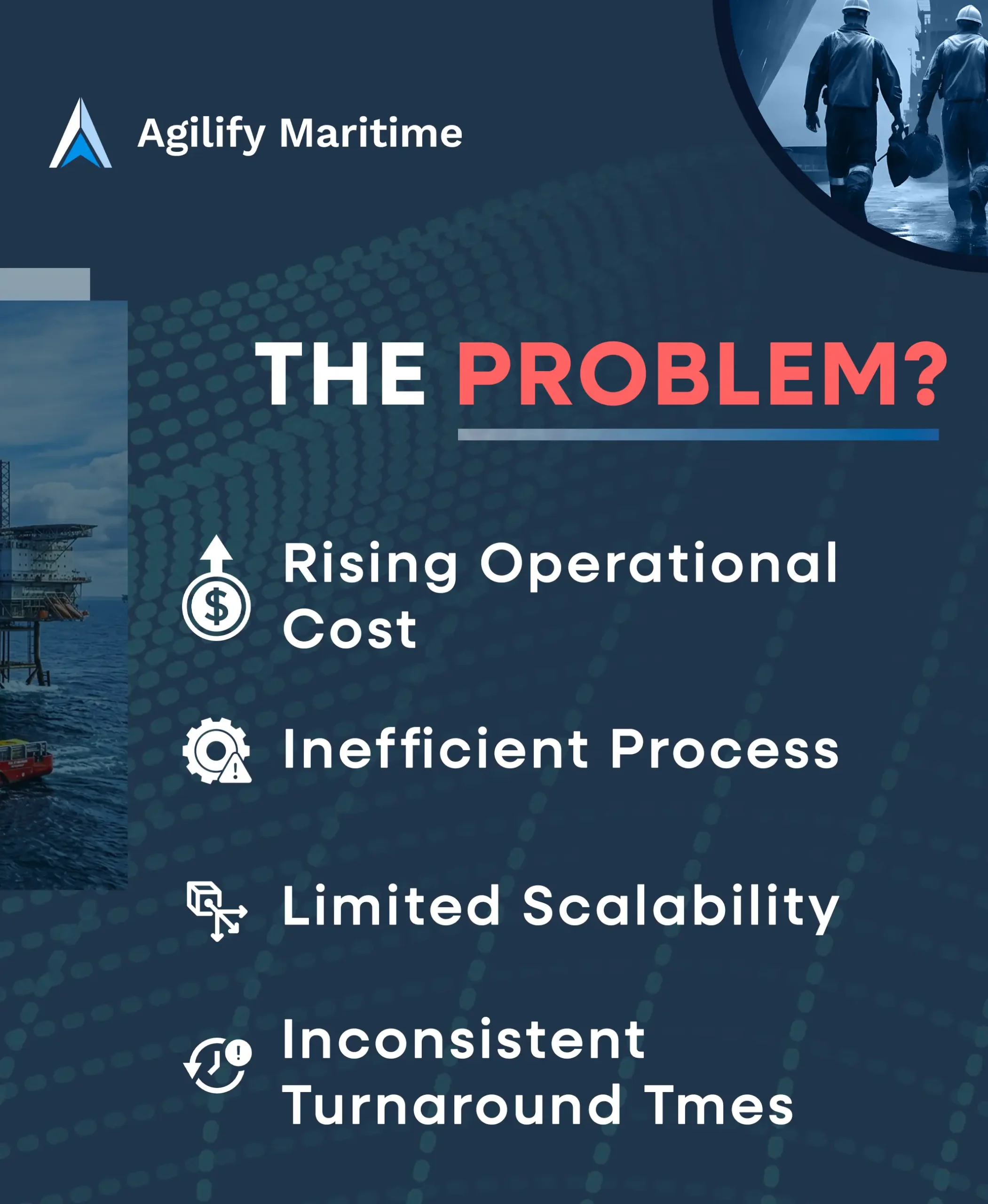
The organization encountered several operational hurdles that hindered performance and growth. High overhead costs associated with maintaining onshore teams significantly impacted their cost structure. At the same time, reliance on manual and inefficient back-office processes resulted in delays, increased risk of errors, and limited visibility across operations.
Additionally, the company faced constraints in scaling its workforce quickly to meet fluctuating demands. Inconsistent turnaround times further affected service reliability, making it difficult to maintain a competitive edge in a fast-paced industry.
The Solution
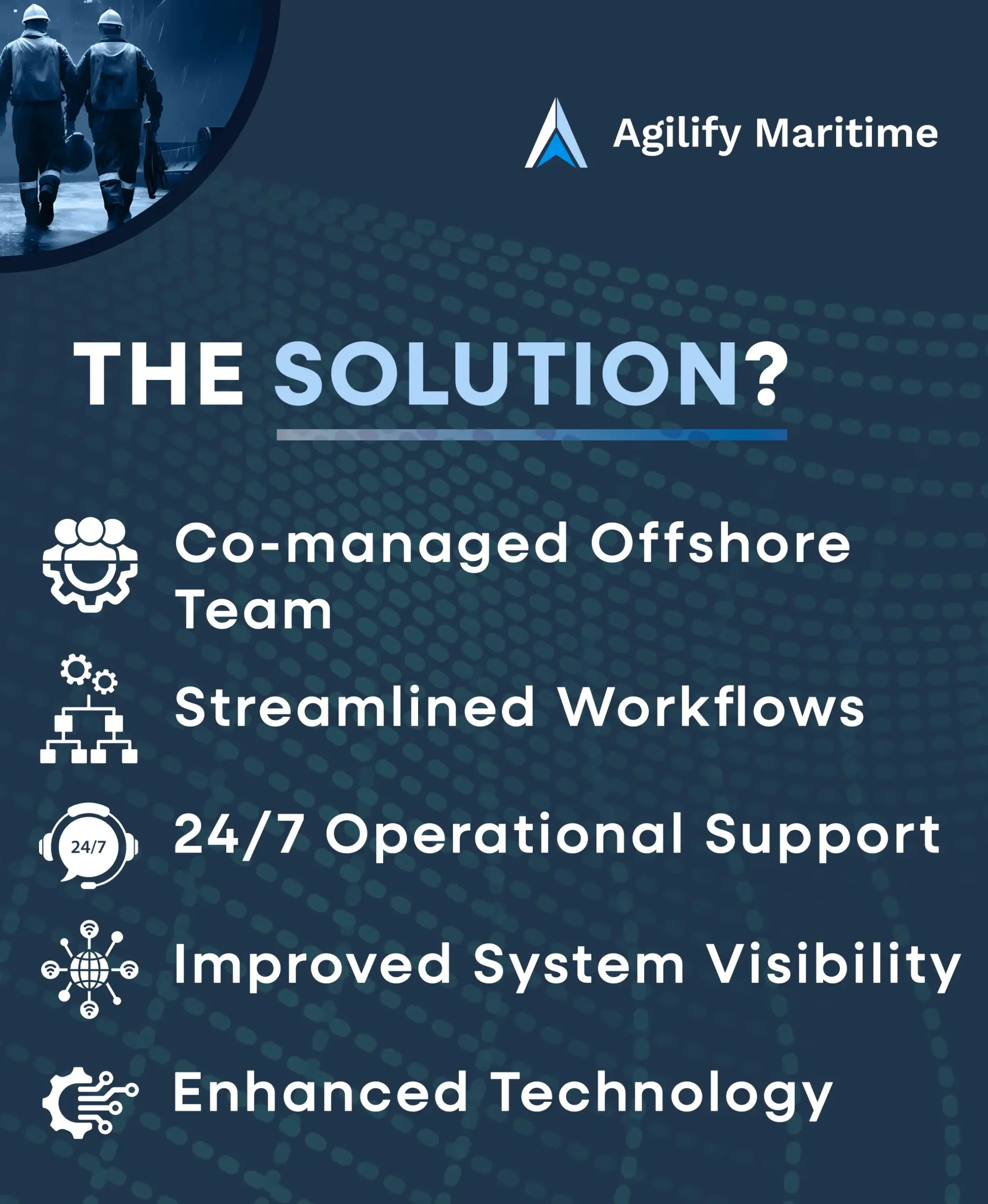
To address these challenges, the company adopted a co-managed offshore team model—a strategic approach that combines dedicated offshore support with direct operational control.
Through this model, the company established a highly skilled offshore team that seamlessly integrated with its existing operations. Workflows were standardized and optimized to eliminate inefficiencies, while digital tools and system integration enhanced visibility and coordination across functions.
The introduction of 24/7 operational support across multiple time zones ensured continuous productivity, faster response times, and improved service delivery. This approach not only streamlined day-to-day processes but also created a more flexible and scalable operational framework.
The Results
The transformation delivered measurable and impactful results across the organization:
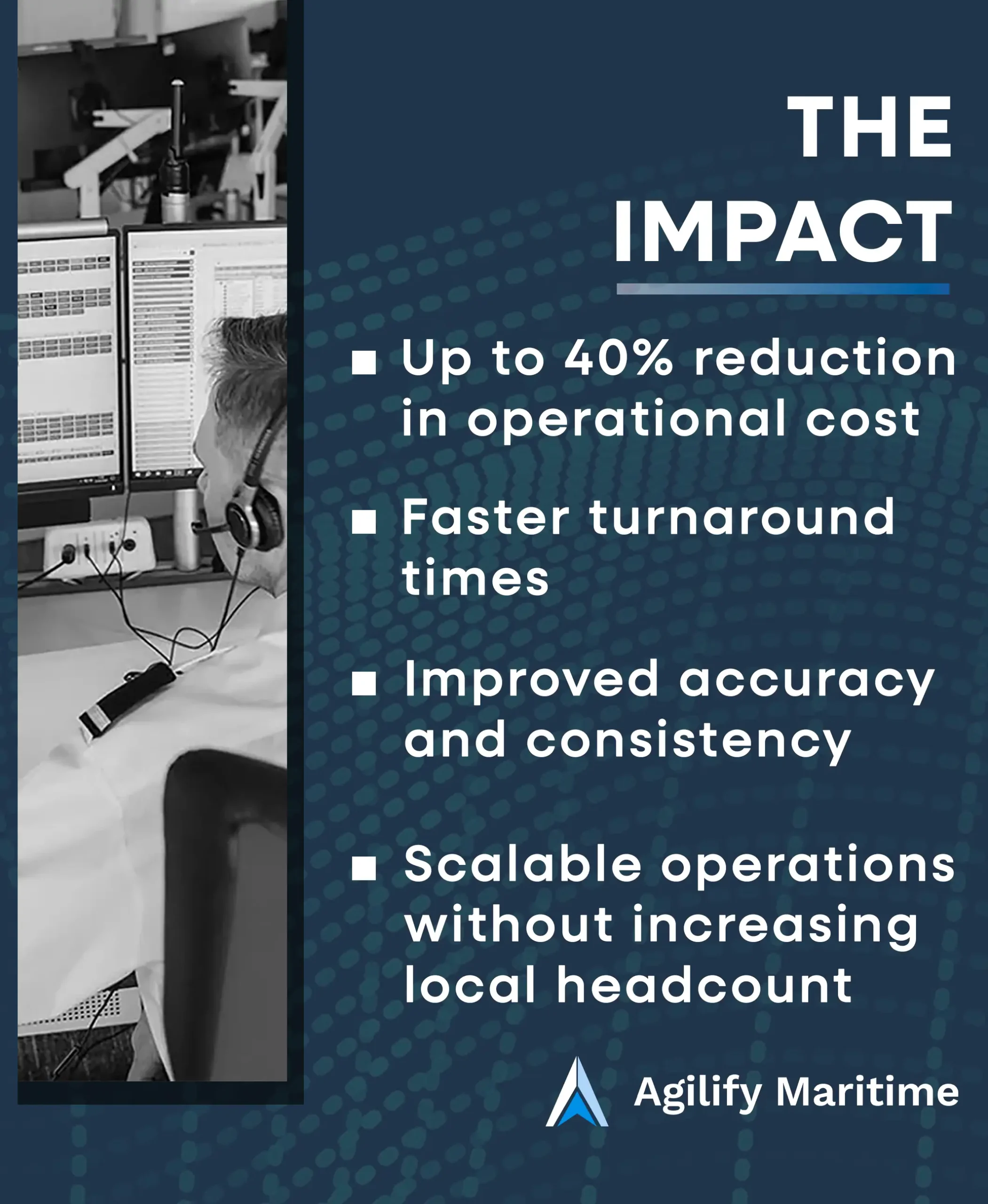
- Up to 40% reduction in operational costs, significantly improving overall profitability
- Faster turnaround times, enabling more efficient service delivery
- Improved accuracy and consistency, reducing errors and enhancing process reliability
- Scalable operations, allowing the company to expand without increasing local headcount
Conclusion
This case demonstrates that cost optimization in maritime operations goes beyond simple cost-cutting measures. By adopting innovative operating models such as co-managed offshore teams, companies can unlock greater efficiency, improve service quality, and build a more agile and scalable organization.
As the maritime industry continues to evolve, organizations that embrace smarter, technology-enabled solutions will be better positioned to navigate challenges and drive sustainable growth.
Book a Session
Connect with our specialists to discuss your needs
and discover the right solutions for your business.